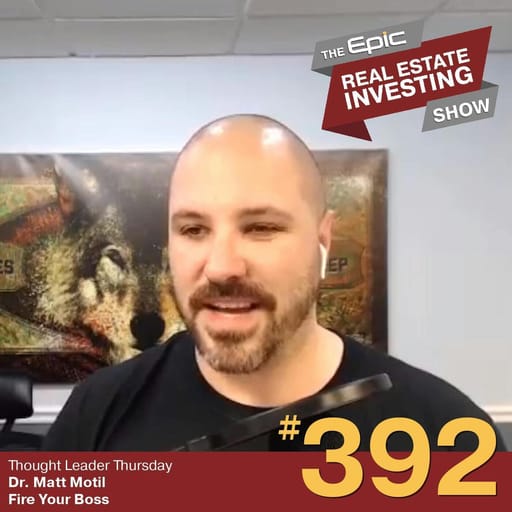
Transcript 0:00 [upbeat music] This is Terio Media. All right. Hello, I am Matt Terio of the Epic Real Estate Investing Show, and this is Thought Leader Thursday. 0:11 [upbeat music] Okay, so today I'm joined by a real estate investor and agent. 0:18 He's had the pleasure of working with hundreds of investors from all over the world, and helped them to grow massive wealth and passive income through remote real estate investments. 0:27 He also leads a small retail real estate team, working with buyers and sellers, servicing all 50 states. 0:32 And in his spare time, he teaches college courses as an adjunct professor at a handful of colleges and universities. So please help me welcome today to the show, Dr. Matt Motil. 0:42 Matt, welcome to Epic Real Estate Investing. Thanks for having me. Appreciate you having me on. Sure, you bet. 0:48 Um, Matt, before we, we dig into your business, what were you doing just prior to getting involved in real estate? 0:55 I've kind of been off and on in real estate since I was in college, so I would say, you know, high school. [laughs] Okay. Yeah. 1:02 But, um, r- my main gig before I was able to quit, and fi- you know, what I say is quit and fire my boss forever, and do real estate full time, was I was in construction. 1:11 So I got an engineering degree, and then went out into the field as an engineer, and then ended up in the construction industry, and I did that for about 18 years. 1:19 So what was it about real estate that you originally found so effec- uh, attractive? You know, I read Rich Dad Poor Dad when I was about 19, and- Mm-hmm... 1:28 um, you know, because I, I saw people living, you know, lavish lifestyles, and I th- and I was raised in the Midwest. I went to college in, you know, in Ohio, and grew up in Ohio and Indiana and stuff. And 1:40 people don't have, like, tons and tons and tons of money in the Midwest. It's just not that way. And- Mm-hmm... and it was like, how, how can I do more, be more, have more? How is that even a possibility? 1:53 And so I liked the title Rich Dad Poor Dad, and so I checked it out, and that really kinda turned me on to the idea of growing wealth through real estate. Got it. Yeah, no, that book has, has transformed many lives. 2:03 Certainly transformed- Yeah... the thinking. Rendered many people certifiably unemployable. Um- Right. [laughs] You know. 2:09 So well, one thing that kinda fell short, and, and, and the critics have kind of all noted this over the years, is that, uh, the concepts and the theory are spot on, right on point, but it fell a little short when it came to the how to. 2:21 So, you know- Mm-hmm... once you had that idea in your head, how did you get started? 2:26 Well, you know, to be perfectly honest, that's a, that's a great, I mean, that's a great insight, because that was really what it was for me. So here I am, 19. 2:34 I have no idea how to get into the real estate business, right? And so and there really is a lack of how to in that stuff, and so I just started, I headed down that path of the Rich Dad series. 2:44 So I just kept reading, like, I went to qu- Cashflow Quadrant, and I did, like, loopholes of, you know, tax loopholes of real estate, and I'm just like, "This is amazing." Mm-hmm. 2:53 And I had no idea, and so really, the, my thought was, a- as, you know, being very naive, you know, at 19 or whatever, was, okay, I gotta go and finish my degree. I gotta go out into the industry. 3:04 I gotta make good money so that I can go to the bank and put 25% down, and get an investment loan, and start buying rental properties. 3:13 And the reality is, I mean, I know now, obviously years later, is that you don't need to use your own money. Mm-hmm. And, uh, it's actually better not to use your own money. It's a whole lot faster. 3:24 Um, but that was my thought process. I was like, "Well, I don't know h- what I'm gonna do, uh, so I better just continue down this path," and real estate, in my mind, at that time, was that was gonna be my side hustle. 3:35 So it was like, that was how I was gonna build wealth, and how I was gonna leave a legacy and all that kinda stuff, but I needed my job, I needed my career to leverage that, um, when obviously looking back on it, 20-some years ago now, 3:49 that's really not the case, but I didn't know any better. Mm-hmm. Got it. Well that's [laughs] 3:54 that seems to be the springboard for a lot of successful entrepreneurs, is they didn't know any better, so they just did it, right? Yeah, and, uh, you know, it's funny, though, because, uh, 4:03 I, I let fear get in the way a lot. Mm-hmm. I mean, it really wasn't... I mean, I quit three years ago now, I was able to go in to do real estate and investing full time, 4:13 but I worked in industry for a really long time, and it really was, uh, uh, a lot of it was the fear of the unknown, and not really knowing what I was doing, and, um, and just letting kind of life get in the way that really stopped me from taking that leap a whole lot sooner. 4:27 Mm-hmm. I mean, I'm glad for my experiences and everything like that, but, you know, I wish I would've started a whole lot sooner than I did. Right. Right. Yeah, I think we all have that thought, right? Sure. 4:36 [laughs] If we only knew then what we know now- Yeah... what could be possible, you know? Yep. So, you know, so how long have you been in the business then? So since you were 19, and how old are you now? 4:45 You look like, what, 21? I'm- 22? Yeah. Uh, no, I've, uh- [laughs]... I'll be 38 here in another month or so, and- Okay... um, so I've been full time in real estate, uh, for about three and a half years now. Um, 4:58 and, uh, but we just kind of did it as, you know, we fell into it on accident, really, um, and just started flipping houses, like house hacking. 5:07 So we'd buy a house that was distressed that we, we moved into, and, uh, you know, I was handy. Mm-hmm. So I just fixed it up while we lived there, and then sold it and made a profit. 5:17 The first time I did it, I was actually transferred from St. 5:19 Louis to Phoenix, and so I had to sell it fast, and I had just finished a bunch of work, and when, when we put it on the, when we had agents come through to tell us what it was worth, they were like, "Well, you can sell it for this." 5:30 And I'm like, "Really?" Right. "Holy cow." Like, um, and it, and it really opened my eyes to... 'Cause, you know, and the books that I had read were really more geared towards buy and hold investing. Mm-hmm. 5:40 And I really... And this was before HGTV made flipping houses popular. Right. 5:46 And we were like, "Wow, I just, I just made some really nice money," and we rolled it into, you know, we just rolled the equity into the next one. Um, and we did that all the way up until 2008. [laughs] Mm-hmm. Okay. 5:57 And then literally watched all of that equity disappear. Um, and we justified it by saying, "Well, it was never really my money to begin with." Bullshit. Uh-huh. 6:05 But, you know, that was what- It, it was definitely your money... we told ourselves at the time. Mm-hmm. It was definitely my money. We just- Yeah... 6:10 foolishly rolled it into the next deal instead of- RightPulling it out. [laughs] Well, don't beat yourself up on that one, 'cause, uh, there's a lot of people- I know... in the same boat, right? 6:19 Yeah, and a lot of people got hurt a whole lot worse than, than I did. But, um, yeah, that was painful for sure. Right. 6:26 Okay, so 20 years from like when your first interest was sparked to, to now, um, 20 years or so, uh, how has your view of real estate changed over the years? 6:35 You know, I was always fascinated with it, and I still, I still love it. I still like it. 6:41 Um, I think it's one of those things, though, is that when you are doing something else and you would love to make your hobby your full-time gig, you, you like sensationalize it. Mm-hmm. 6:51 And so it's like, "Oh, I would love to do this. I'd love to do this." And then there are days where I just go, "I don't wanna really look at houses today," [laughs] Mm-hmm... you know? 6:59 And so it does become, uh, it, it does have the ability to become a little bit of a grind. Mm-hmm. 7:04 Um, and after being involved in a number of different, um, different industries and kind of being tech-savvy and things of that nature, sometimes it's like very, very repetitive, the real estate business. 7:15 I mean, I think it's amazing, and there's probably no better way to make money and make wealth in a very short period of time than to do real estate investing. Um, but it's not the sexiest thing out there really. Yeah. 7:28 I mean, flipping houses is, but I, I'm not a fan, to be perfectly honest. Right, right. We, we will flip if... We will flip houses if, like, it's a great deal, and the numbers make sense, and all that kind of stuff. 7:39 But, uh, you know, for the bang for your buck, I would rather just either buy and hold or wholesale. Right. Totally. I'm, I'm, uh, of a like mind there. Um, so you have a podcast- Mm-hmm... 7:52 and you have a course, so you are an educator. You teach these, teach courses at colleges. And, uh, what's one piece of bad advice out there that you see or hear frequently that just really makes your skin crawl? 8:02 [laughs] I don't know if it's, like, necessarily a piece of advice, but I'm not a huge fan of the guru seminars. Mm-hmm. You know? Like, we have a, we have a course on wholesaling. It takes somebody from- Mm... 8:14 literally zero experience in real estate whatsoever to getting their first deal done. Mm-hmm. And it's just one path. 8:20 I mean, there's, um, obviously there's, you know, there's tons and tons of ways you can get deals done. Right. 8:24 And so instead of inundating people with like, "Here's all of the ways you could do real estate," it's like, "Here's one path. It's very simple. It's very low money out of pocket. 8:32 You don't need credit, and you get deals done." But there's the stuff that we see all the time where, um, it's especially with the TV personalities, you know, like Tarek and Christina before they got divorced. 8:43 You know, "They're coming to Cleveland, and they're gonna do a seminar. And come, it's free." And then the thing is you get there, and it's n- not them. Right. 8:50 And it's, uh, basically just a bait and switch for a, you know, to try to get you to sign up for a three-day thing, which is basically just a big commercial for the 40 to $60,000 guru program. Mm-hmm. 9:04 Those, those irritate me. Sure. So that's probably... You, you know, I know that you were probably looking for something different, but- No... 9:11 like, when people tell me, "Oh, I just spent 40 grand on a, on a seminar," I'm just like, "You know you could have bought a whole house for that, right?" Yeah. Like, [laughs] you know? But then what, right? 9:21 What do you do next after you've bought the house? Well, and, and but then the thing is, it... 9:25 What irritates me the most about that kind of thing is that the majority of the people I talk to that go, "Well, I just spent 40 grand on this," or, "I spent 60 grand on this," and I won't say, you know, specific names of the programs or whatever, 9:37 is that six months later, 12 months later, they still haven't taken action. Mm-hmm. And that, to me, is what I go, "That's wrong." Like, if I'm, if I'm going and investing that kind of capital, 9:49 like, we better be doing deals like right away, [laughs] you know? Mm-hmm. Well, you better take action on the information that you acquire, right? Right. Well, and so that's exactly it. 9:58 So is it bad information that people can't implement, or- Mm... is it just a personality flaw of the person who spent that much money, is that they're just not an action taker? Right. Right. 10:10 So- And I have, I have personal experience with that, being that, uh, when I got started, you know, I spent $22,000 on a program, and that's when $22,000 was absolutely unheard of, so that was probably 13, 14 years ago. 10:22 Sure. There weren't any courses at, at that time, uh, at that price point. [clears throat] But, uh, it was a two-year program. It was, it was taught remotely. And I think about this all the time, and i- it... 10:32 when I educate and I help people get their results, or the results that they're looking for as well, is that I sat in a room, I mean, this was like when it was a really big deal. 10:40 There weren't a lot of people doing this, so the rooms were really crowded. 10:43 So just the fulfillment, like the actual education part of it, not the sales part of it, the education part, you know, there'd be 100, 200 people in the room, and they're all in there listening to, in the same environment with the same materials, listening to the same instructor, giving the exact same information to everybody, and still I look back on this day and, and I'm, uh, I've s- not stayed close to that community, but there, there's a lot of mutual friends and indirect, uh, interactions that I have. 11:08 And I think there's only out of... That was over a three or four-year program. I think more than 30,000 students went through that program. Wow. And, uh, 11:17 when I think of, about the people that I know that are actually out still doing it, I mean, I can count them on one hand, five or six people that are really doing real estate full time. 11:24 I didn't know all 30,000, so there may be more. But I should know more than that, because I knew a lot of people there, you know? Right. 11:30 So, um, but that, and that's, that's, uh, something I always struggle with, and I continue to, and we get closer and closer all the time. We're always making improvements. 11:38 But, you know, inside of your course, inside of your teaching, how do you inspire people to actually take action? I mean, they gotta bring themselves to the game as well. I mean, you can only give them so much. 11:48 They, they do. They gotta connect the dots. Yeah, and you... 11:51 I think the, I think the biggest thing, because ultimately at the end of the day, if you're somebody who is in the education space, or you wanna be in that space, and you want to, like, impact lives, 'cause I think that's the reason why we get into it, is- Mm-hmm... 12:04 y- I think we have a support group for, you know, for people, so they, they do the course. It's all digital and all that kind of thing, but we put them in a group. 12:11 And so then we're in there, and I'm, I physically go in, and I ping people on a regular basis. I'm like, "Where are you at? What are you doing?" You know. Mm-hmm. "What are you taking action? What do you need help with?" 12:20 And-You know the saying, you can lead a horse to water but you can't make it drink. I mean, there's this, to a certain extent there is that. 12:27 Um, but at the same time too, I think if you are engaged with people, um, and try to find out what their sticking point is and try to help them get through it, I mean, that we, we find is a, it's an, you know, a little bit higher level of success. 12:41 Mm. But, um, I think the follow-up and the c- and the continuity after just purchasing a course is really critical because, you know, I mean, it's like a s- it's like a study at-home guide. You know? Mm-hmm. 12:53 You, you can buy the book, but it might sit on your shelf for, you know, forever. Forever. [laughs] And, you know, you never open it. So. Yeah. I've got a lot of those. 13:02 I got a huge queue and I'm like, "Oh, I wanna read this." And then [laughs] it's like- Yeah, yeah... all right, well, after I read the 30 that are ahead of it. [laughs] Exactly. 13:09 [laughs] Yeah, my, my Audible bookshelf is quite extensive. Mine too. And I'm like, I wanna get to that one, I wanna get to that one. 13:15 Every time I go to an event, I hear someone mention a really good book, or every time I talk to someone, say, on an interview, they mention a good book, I go buy it right away. Mm-hmm. And then it sits there forever. 13:22 But, uh, fortunately, I did- That's like, that's like my reminder, right? Yeah. I go to Audible and I'm like, buy. And then I just know I don't have to remember that book 'cause it's in my Audible [laughs] library. 13:31 Right. Right. Yeah, I don't need to worry about that one anymore 'cause I own it, right? Yeah. Fortunately, I've read the right few. 13:36 I focused on the right few and did what they said, and the rest is just, uh, just in case learning, as we call it. Um, cool. So let's get really practical here. I visited your website, and- Right... 13:46 the theme there is all around firing your boss, and this is something that you had experience with, I guess, about three years ago when you went full time. Right. 13:52 Um, so if someone came to the conclusion that this is what must be done for themselves, I must fire my boss, what are the first three things that they should do? Um, o- one is, I, I tell people... 14:06 'Cause I put together a guide. It's, it's a free thing we have on our website. It's called The Pissed Off Guide to Financial Freedom. Nice. 14:11 And, um, the whole idea is, you know, obviously if you're upset about being employed, then [laughs] you know- [laughs]... you get pissed off after a certain point. Um- I like it... 14:20 and also the idea that I believe that if you're some, you know, from millennial to mid-40s, you probably at some point are feeling like you've been lied to with society- Mm-hmm... 14:31 of herding us through, you know, the, what I call the middle class trap. But, um, I tell everybody you need to have a budget, you know, for your personal life. 14:41 You gotta get, you gotta get really serious about your expenses because, um, if you wanna quit your job, you're gonna have to do something different to generate money to replace that income. 14:52 And the cheaper you can live, obviously, the faster you can make that happen. Mm-hmm. 14:56 And so I think a lot of times is people go, "Well, I really wanna do my own thing, and I want financial freedom, and I want this and I want that," and it's like, okay, great, you know, you make $50,000 a year and you're going to Starbucks every day. 15:07 You know, you're spending, you know, uh, $150 a month on coffee. You know, is this really what you should be spending your money on? So the number one thing is I tell everybody, you need to make a budget. Okay. 15:18 And then, um, so the first thing is make a budget, and then kind of like part 1B is you need to get really serious about where you're spending your money and what you can cut, and you need to cut everything that you possibly can, um, to do that. 15:31 Then step two is I tell everybody, and it's kind of like, um, there's a book out called Start, uh, Start at the End, I think is what it's called. Mm-hmm. Um, and it's a, it's a great book. 15:42 It's kind of the idea, uh, if you know who Frank Kern is, Frank had a talk that he did years ago, um, called Core Influence. Mm-hmm. 15:51 And it's a two-part thing, and part one is basically decide, you know, figuring out who your ideal client is if you're in sales. Uh, the second part is really designing your ideal lifestyle. Mm-hmm. 16:01 And so what I always tell everybody is step two is what, what do you, what do you envision of where you wanna go? 16:09 Because when you start with the end in mind, you can reverse engineer the entire process, and then you can get really super clear on how am I spending my time, and is how I'm spending my time aligned with 16:24 m- my, my big goal, you know? Mm-hmm. Am I spending my money on the right things? Am I spending my time on the right things? Are my actions progressing me towards what it is that I ultimately want to achieve? 16:35 Um, so those, you know, those three things are, are, are a really good foundational point to get very, very clear on what you want and where you wanna go. Okay. So number one was make a budget. Right. 16:46 Specifically, look at your expenses, see what can be reduced there, right? Yep. Okay. Second thing- Two was cut your budget. [laughs] Cut your budget. Very good. Slash your budget, budget. 16:55 Uh, second thing was to start at the end and kinda reverse engineer the path? Yep. Okay. Yeah. And then third thing was... Uh, get really clear on your time. So I, I recommend everybody do a time study. 17:06 Because the reality is if you're going to, um, you know, ultimately what you're gonna need to do is you're going to have your side hustle replace your main hustle, right? Mm-hmm. 17:16 And so there's only so many hours in the day, and if you're working a job for somebody else, which is w- you know, where the whole fire your boss thing comes in, you're probably working at least 40 hours a week, maybe more. 17:27 Um, and so you're gonna need to fit this side hustle in around your normal job, you know- Mm-hmm... hopefully some kinda self-care, 'cause, you know, the problem is you're gonna be burning at both ends. 17:40 And so if you're not taking care of yourself, you're gonna go down in a hurry. 17:43 Um, and then around family time, if, you know, if you've got a spouse and kids and all that kinda stuff, and then you've gotta fit all this in. 17:50 And so I think time blocking is huge, but the thing is, as you're, as you're blocking out your time and you're figuring out where you're spending your time, you have that clarity of where am I going, and what am I doing, and, and why am I doing this? 18:02 And it helps to really kind of get all that together. Nice. Nice. So. Good advice. It doesn't... You know, a lot of people are like, "Well, you gotta figure out what you wanna do." 18:10 I, it, you really can kinda plug anything into that. I mean, at, at the end of the day, I mean, you know, we're obviously, this is a real estate show, so we're, we're passionate about real estate, but not everybody is. 18:21 Mm-hmm. And while that's the path that I took, and that's the one that I, I help people do as well, um, there's lots of stuff out there. 18:29 There's digital marketing, there's affiliate marketing, there's, you know, you could, uh, sell stuff on the internet, you know, e-commerce. 18:36 There's all kinds of stuff that you can do to make a really good amount of money, um, in a relatively short period of time on the side. Mm-hmm. 18:46 But so, you know, that, so I guess that would be the fourth step is figure out your passion, but- Sure... you know. I like it. I like it. Yeah. I didn't ask for four, though. Just kidding. [laughs] I know. 18:57 [laughs] Awesome. Matt, it's been a pleasure. If someone wanted to get in contact with you and learn more about you, what would be the best way for them to do that? Uh, best way is go to the website drmattmotil.com. 19:08 Uh, M-A-T-T M-O-T-I-L, drmattmotil.com. And we've got a contact form on there, or you can send me a message right there. There's links to, uh, our podcast show. You can get a free copy of my bestselling book on there. 19:20 Just throw us a couple bucks for shipping. You can get the free Pissed Off Guide to Financial Freedom. All that stuff is really, the website's really the hub, so that's really the best way to go. Nice. 19:30 That is drmattmotil.com? Correct. Perfect. Well, it's been a pleasure, Dr. Matt. Thanks for being here. Yeah. Thanks for having me. You bet. It's been fun. Absolutely. Always is. Let's do it again. Okay. Cool. All right. 19:44 That's it here at The Epic Real Estate Investing Show. I will see you next week for another episode of Thought Leader Thursday. Take care. [swish] [whoosh] This podcast is a part of the C-Suite Radio Network. 20:00 [whoosh] For more top business podcasts, visit c-suiteradio.com. [sword slicing]